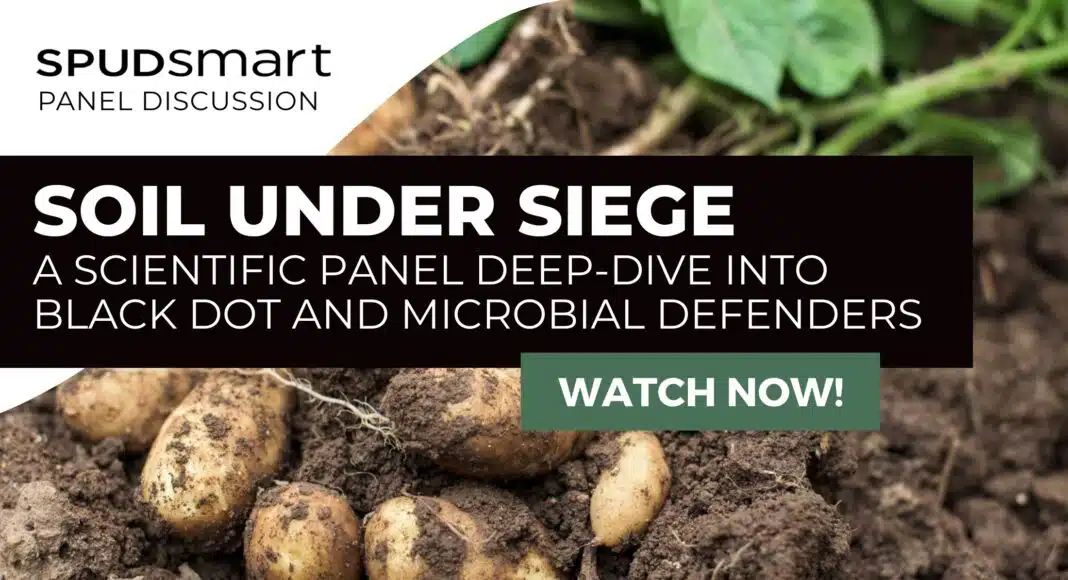
Black dot is on the rise in potato fields, and farmers are worried — with good reason.
Though it’s not a new disease, it’s a growing and incredibly tough to manage problem that can steal yield, blemish tubers, and reduce marketability. I’ve talked to a lot of farmers who are genuinely daunted by what can feel like an unwinnable battle.
That’s why I jumped at the chance to be part of the Soil Under Siege panel discussion (https://spudsmart.com/panel-now-live-soil-under-siege-tackles-the-war-beneath-your-crop/). I knew it would be a chance for me and two of my colleagues — Dr. Gary Secor, a plant pathologist at North Dakota State University with decades of experience tracking soil-borne potato diseases, and Joy Youwakim, a soil microbiologist focused on beneficial microbes and the living networks that build crop resilience — to pool our expertise and deliver practical, real-world answers to farmers at a time when farmers need that information most. With nearly 2,000 views in the first week alone, it is clear growers are hungry for real solutions.
Secor laid out what we know for sure about black dot. The disease has been emerging for 40 years but, as yields and marketability are now more and more critical, its impact is now a major concern. The pathogen persists in the soil over the long-term, which means crop rotation doesn’t work. There are no resistant varieties. Seed treatments don’t work well. There are no post-harvest fungicides. And fumigation choices are narrow.
Even so, there are bright spots. On-farm research trials show the fumigant chloropicrin (Strike) can reduce black dot levels while promoting beneficial soil organisms. Many people are surprised to hear that a fumigant can actually help soil biology, but that is what early data is showing us.
The biology beneath our boots is a big part of this story. As Joy Youwakim highlighted on the panel, beneficial microbes can play a role in suppressing disease. The science is young, but it is moving quickly. To me, the future of disease management will combine chemistry, biology, and smart agronomy in ways we are only beginning to understand.
My advice is to keep detailed field records, scout regularly and test ideas. Bring in people who can help. Be open to change. Every step we take toward understanding and managing black dot is a step toward healthier, more profitable crops.
If you have not yet watched the panel, I invite you to check it out. The more we share what we know, the stronger we all become. Watch Soil Under Siege now at SpudSmart.com here: https://spudsmart.com/panel-now-live-soil-under-siege-tackles-the-war-beneath-your-crop/.