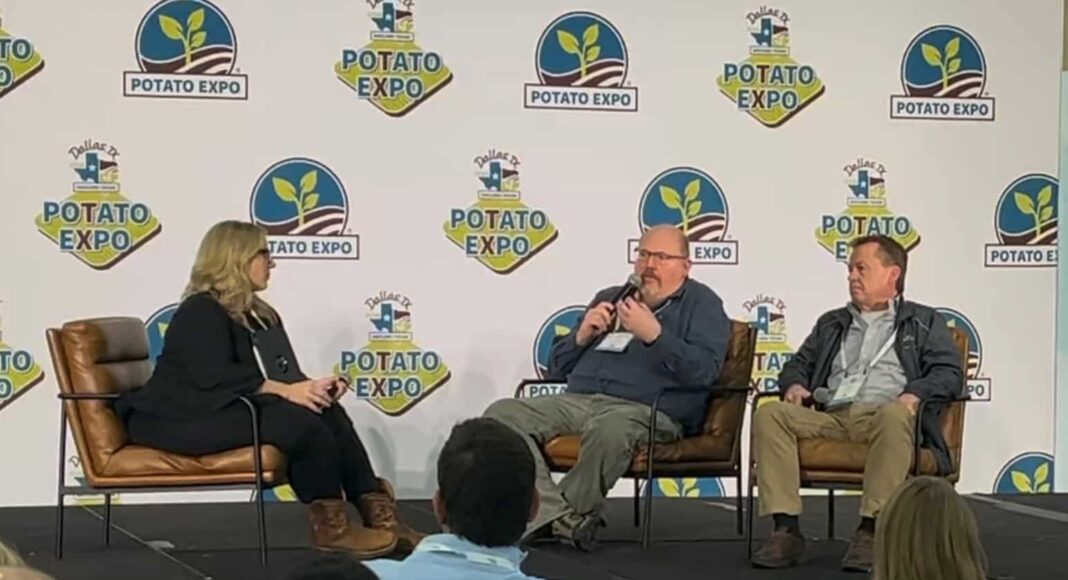
Earlier this month at Potato Expo 2026 in Texas, I had the opportunity to participate in a panel discussion on potato quality alongside Seed World U.S. Editor (on behalf of Spud Smart) Aimee Nielson and Jeff Douglas of Douglas Agricultural Services.
Our goal was simple: help growers with real solutions.
Our point of emphasis: prioritizing marketable yield over total yield.
Over the years, I’ve seen countless fields produce impressive tonnage—only to lose value through scab, poor skin finish, and tuber defects. Quality losses are rarely dramatic. More often, they accumulate quietly over the season, steadily eroding returns.
Not surprisingly, common scab dominated much of the discussion. Its inconsistency from year to year feeds the perception that it’s largely outside grower control. But the panel kept returning to one core idea: systems thinking.
Genetics influence risk.
Soil moisture at tuber initiation shapes outcomes.
Soil pH matters.
Soil biology matters.
Targeted chemistry—when used intentionally—matters too.
Tools like soil fumigation with Strike® (active ingredient: chloropicrin) can play an important role when they support the larger system. No single input solves the problem on its own. It’s the combined effect of these decisions that ultimately shows up in the barn.
The conversation around rented ground especially resonated with growers in the room. Managing quality on land you only control every three or four years forces difficult trade-offs. Long-term soil adjustments aren’t always realistic, and decisions around pH, biology, and disease suppression must fit within a narrow window.
Quality is still achievable under those conditions—but it requires sharper prioritization and a clear understanding of what each tool can realistically deliver.
What I appreciated most about the discussion was the shift away from inevitability.
Soil-borne diseases often feel like something that “just happens.” The goal of the panel wasn’t to oversell solutions, but to reinforce a sense of agency—that quality can be influenced, managed, and protected when the crop is viewed as an interconnected system rather than a series of stand-alone inputs.
As we agreed at Potato Expo, success comes to growers who stack small advantages, manage risk deliberately, and prioritize the portion of the crop that actually generates revenue. When those choices stay aligned from planting through storage, marketable yield follows.

Read the full article on Spud Smart:
https://spudsmart.com/scab-quality-and-marketable-yield-lessons-from-potato-expo/
Have questions about your field?
Email us at info@strikefumigants.com to start the conversation.